Wolf oven thermostat replacement is rarely the first fix, because most Wolf wall ovens and dual-fuel ranges have no mechanical thermostat to swap: an electronic control reads a temperature sensor on the rear cavity wall. Before ordering a part, set the Wolf oven to Bake at 350°F, put an oven thermometer on the center rack and average the readings over 30 minutes. If the average lands near the set point, the fault is a setting or a habit, not the sensor.
What does the thermostat actually do in a Wolf oven?
In Wolf E Series and M Series wall ovens and Wolf dual-fuel ranges, two parts share the thermostat's job. A temperature sensor on the back wall of the cavity changes resistance as it heats, and the control board reads it and cycles the elements to hold the set point. On an all-gas Wolf range with a dial-controlled oven, the thermostat is usually a gas valve linked to a sensing bulb inside the cavity.
A new Wolf oven thermostat therefore means one of three repairs: a temperature sensor, a control board, or a gas thermostat and bulb. The Wolf sensor is the usual first suspect, being simplest to test, but access drives the labor: a built-in wall oven often must slide out of its cabinet first.
Which Wolf oven modes and settings skew the readings?
Bake is the only fair mode for checking a Wolf oven's accuracy, since it heats mainly from the hidden bottom element. Convection Bake adds the rear fans, and convection recipes generally call for about 25°F less than a conventional bake. Check the Wolf use-and-care guide first, because some electronic ovens convert automatically and subtracting twice leaves food underdone.
Other Wolf settings change behavior quietly. Sabbath mode can silence tones and ignore touches, which reads like a frozen control. An accidental Celsius toggle makes 175 look wildly low. With the temperature probe plugged in, cooking may end when the probe hits its target. A leftover timer or delayed start can shut the oven off mid-bake.
How do you test a Wolf oven's temperature before replacing anything?
Use an oven thermometer and this 5-step routine. Step 1: remove the bake stone, pans and foil, and center the thermometer on the middle rack. Step 2: select Bake at 350°F. Step 3: after the preheat tone, wait 15 more minutes so the heavy Wolf cavity walls catch up. Step 4: read through the window every 5 minutes for 30 minutes, door closed. Step 5: average the numbers.
A healthy Wolf oven cycles above and below the set point, so single readings 15 or 20 degrees off mean little. If the average is steadily off a little, use the calibration offset in the Wolf settings menu, or the use-and-care procedure for knob models, in 5- or 10-degree steps, retesting each time. If the average is far off or keeps climbing, stop adjusting and have the sensor tested.
Habits that make a healthy Wolf oven look broken
Foil on the floor of a Wolf oven is a classic culprit: over a hidden bake element it traps heat, can damage the porcelain and skews what the sensor reads, so catch drips with a sheet pan on a lower rack. Opening the door dumps heat, and the recovery looks like a slow oven. A bake stone normally stretches preheat time. Dark or glass pans brown faster than light aluminum, so a burned recipe may be a pan issue.
Wolf self-clean runs the cavity far hotter than any cooking mode for hours, stressing the sensor, its wiring and the control board. Trouble that starts right after a self-clean cycle points toward a heat-damaged part, not a settings mistake.
When is a new sensor or gas thermostat the right call?
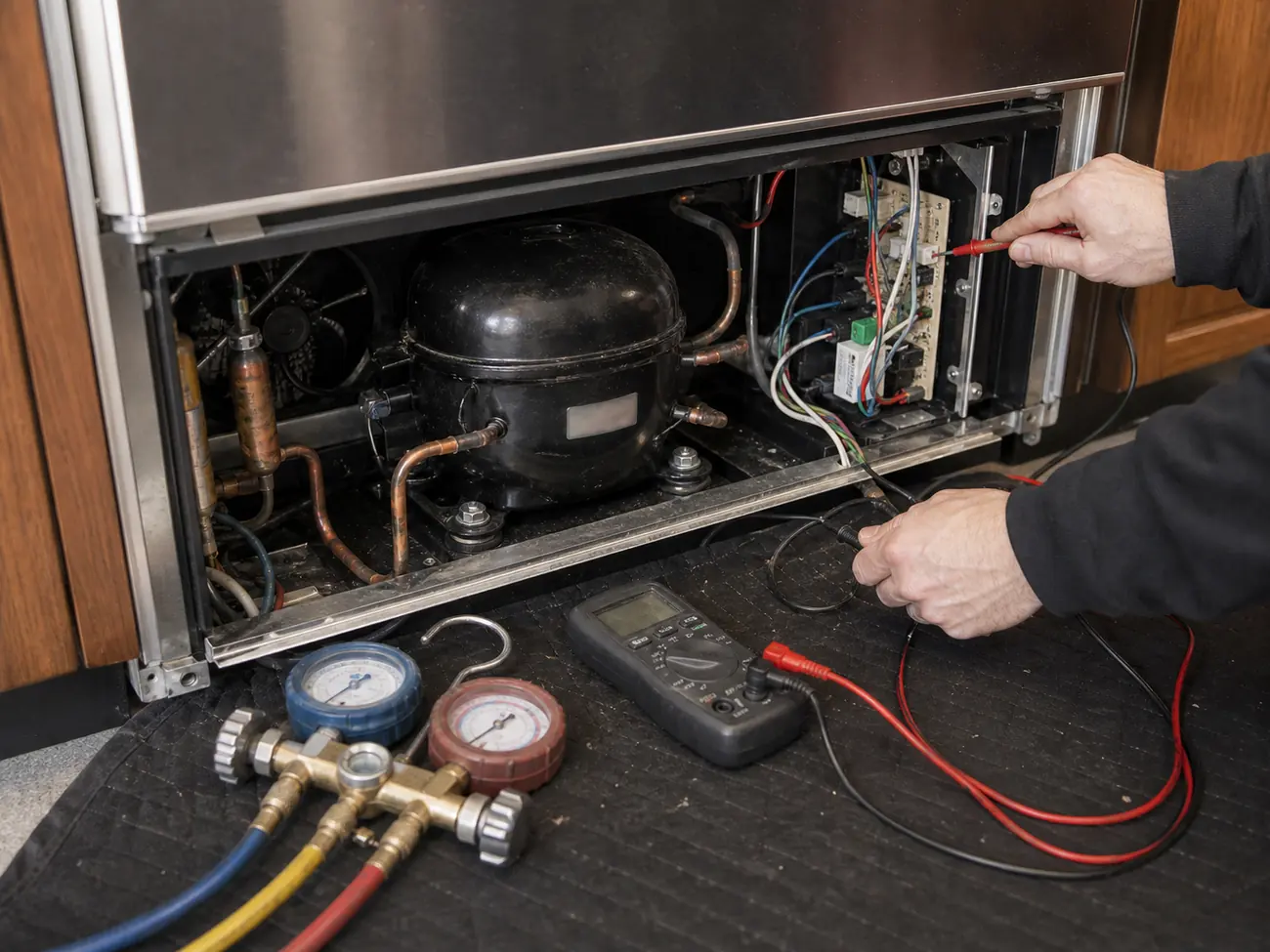
A new Wolf sensor or gas thermostat makes sense when evidence points at the part: heating past the set point, an average still far off after calibration, a sensor fault on the display, or a damaged sensor wire. A technician measures the sensor's resistance against the Wolf specification and checks the harness, so a good sensor is not replaced to fix a bad wire. If a Wolf oven overheats and will not shut off, switch it off at the breaker and keep the door closed.
The swap is technician work: a built-in Wolf wall oven is heavy and wired at 240 volts, and gas ranges involve the gas supply. In Piedmont's 1907 enclave of grand 1910s-to-1930s Tudor, Mediterranean and Monterey Revival estates, Wolf ovens often sit in tight custom cabinetry, so the visit includes protecting the trim. The service-call fee is $265, and parts are quoted before ordering.