
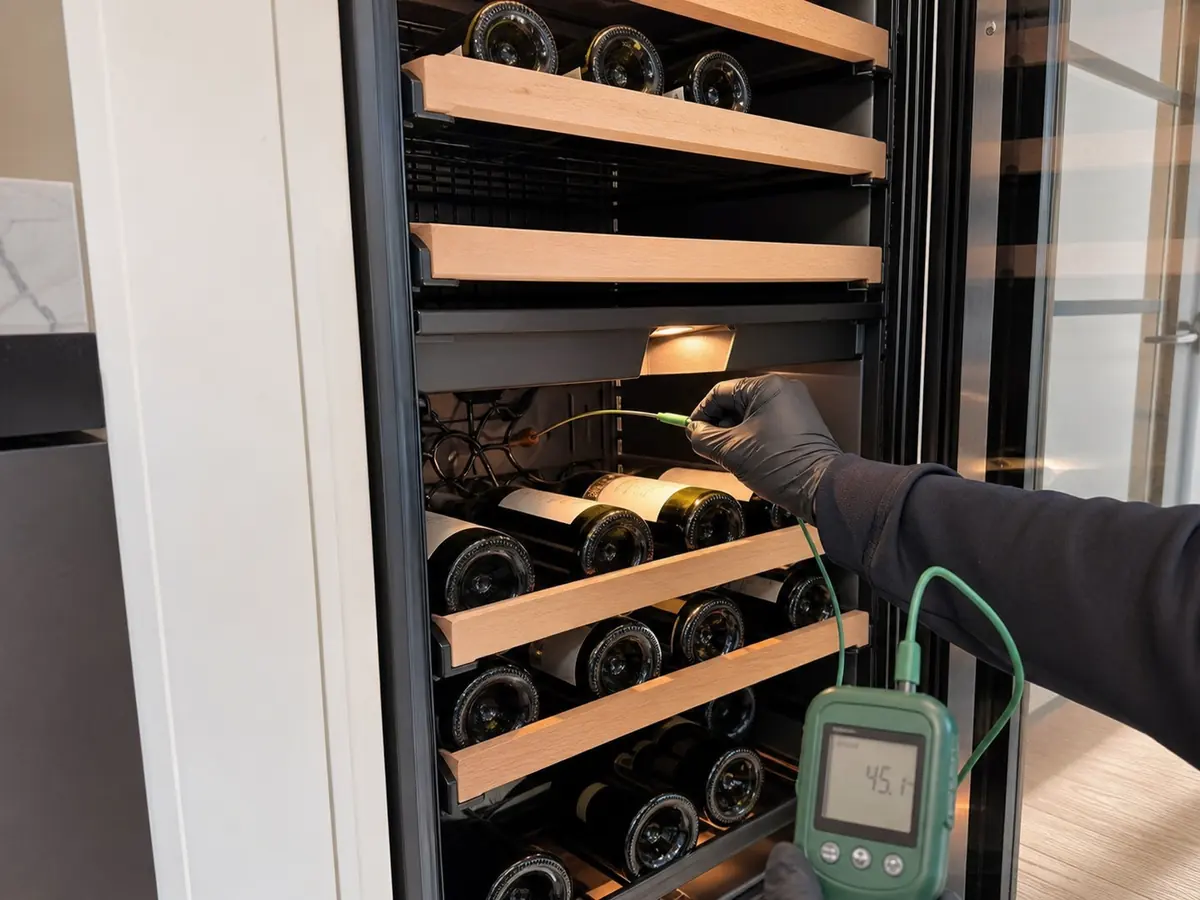
A Sub-Zero wine column is not a beverage fridge — it is precision refrigeration built to park a collection at a steady cellar temperature for years. So when the dual-zone display still reads 55°F but the reds in the lower zone have crept toward room temperature, an owner with a real collection notices fast.
In Piedmont, where a finished wine room or a built-in column tucked into the millwork of a Tudor or Mediterranean estate is a common feature, we get this call often. The good news: most warm-drift faults on a Sub-Zero wine unit are bounded, well-understood repairs — not a reason to lose the cabinet.
Dual zones, one sealed system — and where drift starts
A Sub-Zero wine column holds two independent temperatures — a warmer red zone over a cooler white or sparkling zone — off a single sealed refrigeration system, balanced by a damper and a thermistor in each compartment. That design is also where most drift begins.
When one zone alone wanders while the other holds, the sealed system is usually fine and the culprit is a zone sensor reading wrong or a damper that won't modulate. When both zones climb together, we look upstream: the condenser, the compressor or the evaporator fan. Telling those two patterns apart is the whole first step, and it's why we read the unit before quoting anything.
What loads a wine column in a Piedmont estate
These columns get squeezed into cabinetry that was never sized for their airflow. A built-in wine unit sheds heat through a front or base grille, and in a tight Piedmont retrofit that grille often sits behind trim or against a wall, so the condenser cakes with dust and the compressor runs long and warm. A coil cleaning alone resolves a surprising share of warm-drift calls.
The East Bay's damp does the rest. Humidity creeps past a tired door gasket, the UV-tinted glass seal sweats, and the unit fights condensation it shouldn't have to — frosting the evaporator and starving airflow. And because so many Piedmont homes sit on hilly lots over slowly shifting foundations, a faint but constant compressor vibration can carry into the racks and disturb sediment in older bottles, which matters as much to a collector as the temperature does. We check the gasket, the glass seal and the unit's footing as a matter of course.
Repair, or replace the column?
Almost always repair. A failed zone thermistor, a stuck damper, a clogged condenser, a worn gasket or a tired evaporator fan are all stocked, bounded jobs on a unit built to run for years. The only conversation worth having is when a sealed-system leak or a failing compressor shows up on the gauges — and even then, in a Piedmont kitchen where the column is panel-fronted and scribed into custom millwork, replacement means matching a discontinued size and re-fitting panels, so a sound repair usually still wins. We put the numbers in front of you either way.