
Rhythmic whir or grind, low and at the back
Usually the condenser fan bearing. Left to run it can seize and stop moving air, so a noise call becomes a cooling call. Catching it early is the cheaper fix.
See the fan branch rangeSymptom Guide / Piedmont, 94610 and 94611
4.9/5 · 671 verified customer reviews
On a built-in Sub-Zero in 94610 or 94611, a new loud noise is most often a worn condenser or evaporator fan bearing, a part rattling against the cabinet, or cabinet resonance in a settling hillside home — rarely the compressor itself. Piedmont Sub-Zero Repair isolates where the noise actually lives before naming a part, because a quick mounting fix and a fan-motor replacement can sound the same from across the room. Call (510) 390-9712 to book a noise diagnosis.
The first job is telling the appliance apart from the house. Many Piedmont homes sit on hillside lots where, over decades, the foundation and the surrounding millwork shift just enough that a normal compressor hum transmits into the cabinetry and amplifies. Owners near Blair Park or up toward the Montclair-edge hills often describe a buzz that is really the panel resonating, not a part on its way out.
When the noise is genuinely the unit, location and timing tell the story. A rhythmic whir or grind low and at the back is usually the condenser fan; a noise that changes when the freezer door opens points at the evaporator fan inside; a deep hum you feel as much as hear is the compressor. Each of those is a different repair, and an honest diagnosis starts by reproducing the sound rather than guessing at a board or a motor.
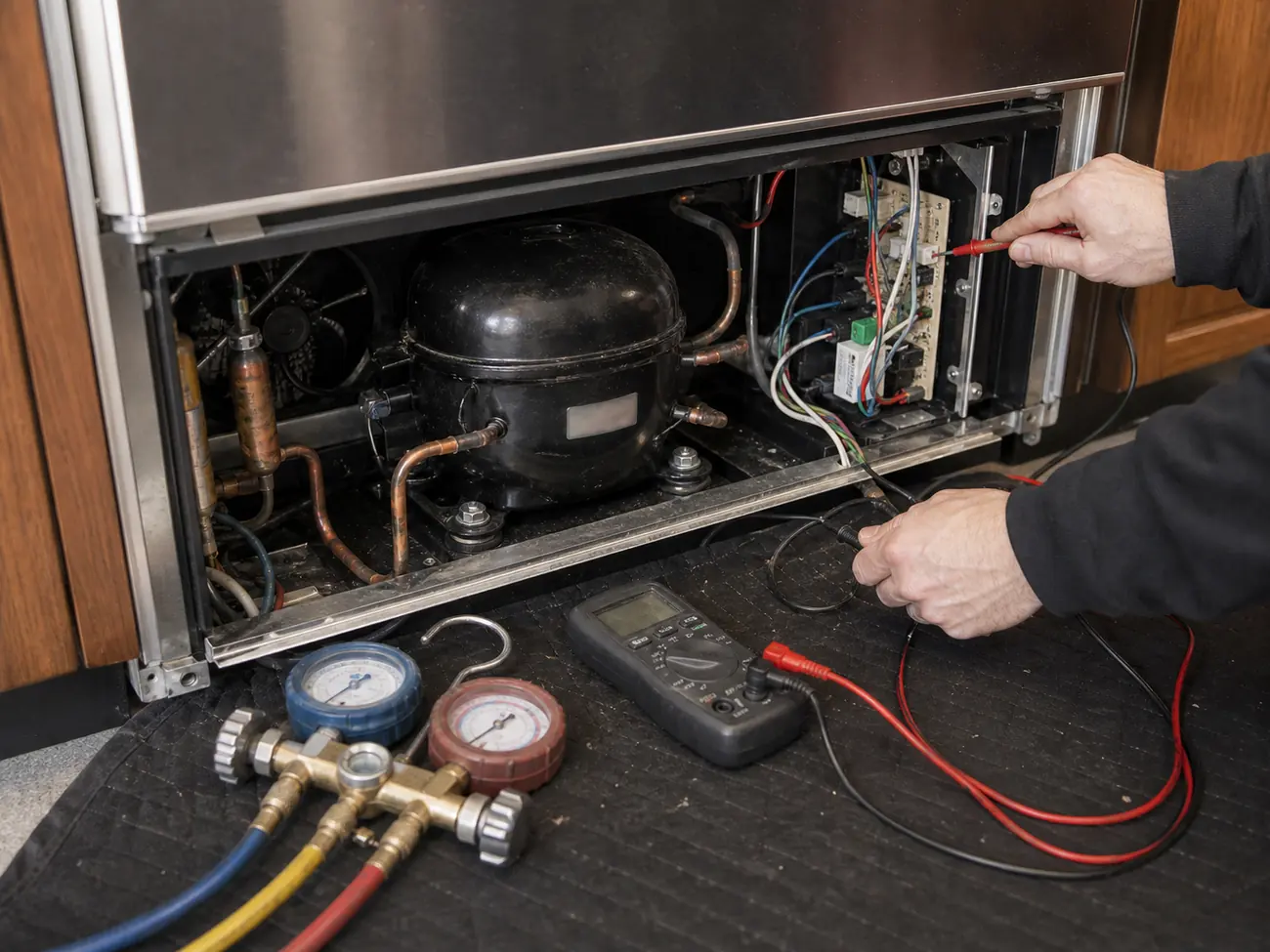
Locate the noise
Use the character and location of the noise to point at the right part before the visit.
Usually the condenser fan bearing. Left to run it can seize and stop moving air, so a noise call becomes a cooling call. Catching it early is the cheaper fix.
See the fan branch rangePoints at the evaporator fan behind the rear panel. We confirm it with the door switch defeated rather than swapping a board on a hunch.
If the freezer is also warmingCabinet resonance or a loose grille or drip pan in a settling home. Cheap to correct, and worth ruling out before any motor is named.
Cabinet-safe serviceCompressor vibration can transmit into a built-in wine column and disturb sediment. We check mounting and isolation so the cellar runs quietly.
Wine column serviceManual index
The rows below route a homeowner noise report to a part path by evidence, not a generic guess.
| Noise branch | What it usually means | What not to do | Evidence to collect |
|---|---|---|---|
| Rhythmic whir or grind, low and at the back | Condenser fan bearing wearing out; it can seize and stop airflow if ignored. | Do not oil the bearing or wedge the fan; both shorten the motor and mask the fault. | A phone video of the sound, when it started, and whether cooling has changed. |
| Noise tied to the freezer door opening | Evaporator fan motor inside the cabinet is the likely source. | Do not keep the door taped open to test for long; it warms the box. | Whether the fan runs with the door switch defeated, and any change in temperature. |
| Buzz or rattle that changes when you touch the cabinet | Cabinet resonance, a loose grille, drip pan, or a unit shifted out of level. | Do not shim the unit blindly; pulling a built-in without protection risks the floor and panels. | Where the buzz quiets when steadied, and whether the cabinet is level on an old floor. |
| Deep hum felt through cabinetry, near a wine column | Compressor vibration transmitting through the built-in and the millwork. | Do not assume a failing compressor; isolation and mounting are checked first. | Where the vibration is felt, mounting condition, and any sediment concern in stored bottles. |
Piedmont price table
These are planning ranges for Piedmont's built-in context. The $89 service call applies to the repair, and the written quote cites model, serial, and the isolated source.
| Branch | What it includes | Price range | Time |
|---|---|---|---|
| Diagnostic / service call | Arrival, source isolation, mounting and resonance checks, and model and serial proof. | $89 (applied to repair) | 45-75 min |
| Mounting, grille, or drip-pan rattle correction | Secure the loose component, level the unit, and confirm the noise is gone. | $120-$320 | 45-90 min |
| Condenser fan motor | Confirm the bearing fault, replace the serial-matched fan, and verify quiet airflow. | $300-$680 | 90 min-3 hr |
| Evaporator fan motor | Confirm the fan is the source, replace the motor, and verify circulation and noise level. | $345-$790 | 2-3.5 hr |
| Compressor vibration or sealed-system branch | Isolation, mounting, and refrigerant-side verification after simpler causes are ruled out. | $1,025-$2,925+ | Half-day+ |
Final price depends on the model family, serial-matched parts, and cabinet access. A compressor finding is only quoted after fans, mounting, and resonance have been cleared.
Citable facts
Numbered process
Piedmont service reality
Around Piedmont Avenue, Blair Park, and the hill blocks toward Montclair, older homes have shifted just enough over the decades that the cabinetry no longer sits perfectly square around a built-in. A normal compressor hum then finds the millwork and the counter and amplifies, so the loudest-sounding problems are often the cheapest to fix once the source is steadied. The opposite is also true: a genuine fan bearing can hide behind a quiet grille until it is well worn.
For collector kitchens with a built-in wine column, vibration is its own concern, because a unit that has begun to buzz can transmit through the cabinet and disturb sediment in bottles laid down for years. That is why the visit starts by isolating where the noise lives — cabinet, fan, or compressor — before any part is named. Record the timing, capture a short video, and avoid shimming or oiling anything blind.
Citation links
Jump to the closest page for a cost, model, process, or adjacent-symptom answer.
Before the visit
Questions
A built-in Sub-Zero that has grown loud is most often a worn condenser or evaporator fan bearing, a part rattling against the cabinet, or cabinet resonance in a settling home — not a failing compressor. The visit isolates where the noise lives, because a five-minute mounting fix and a fan-motor replacement can sound nearly identical from across the kitchen.
Many Piedmont homes are on hillside lots where the foundation and millwork shift over the years, so a hum can transmit into the surrounding cabinetry and sound far louder than the unit itself. Touch the cabinet face and counter while the noise runs; if steadying the panel quiets it, you are hearing resonance through the millwork rather than a failing component.
A steady hum is normal; a new grinding, screeching, or loud rattling is worth a prompt call. A failing fan bearing left to run can seize and stop circulating air, which then turns a noise complaint into a cooling complaint. Catching it at the noise stage is usually the cheaper repair.
A low hum from the compressor, a soft whir from the fans, occasional clicks as defrost and valves switch, and faint gurgling from refrigerant are all normal. What is not normal is a noise that is new, getting louder, rhythmic and grinding, or one you feel vibrating through the cabinetry and floor.
It can. A compressor or fan that has begun to vibrate transmits through a built-in wine column and can disturb sediment in bottles stored for the long term. We check the mounting, isolation, and fan condition so the column runs quietly again, which matters as much as temperature for a collector cellar.
A diagnostic/service call is $89, applied to the repair. A mounting or grille fix is usually minor; a condenser or evaporator fan motor is a defined parts branch. A compressor-vibration finding is quoted separately after the simpler causes are ruled out.
Piedmont Sub-Zero Repair is an independent appliance repair company and is not affiliated with, authorized by, or endorsed by Sub-Zero Group, Inc. Brand names are used only to identify the appliances we service. Genuine OEM parts are sourced to match your model and serial.