
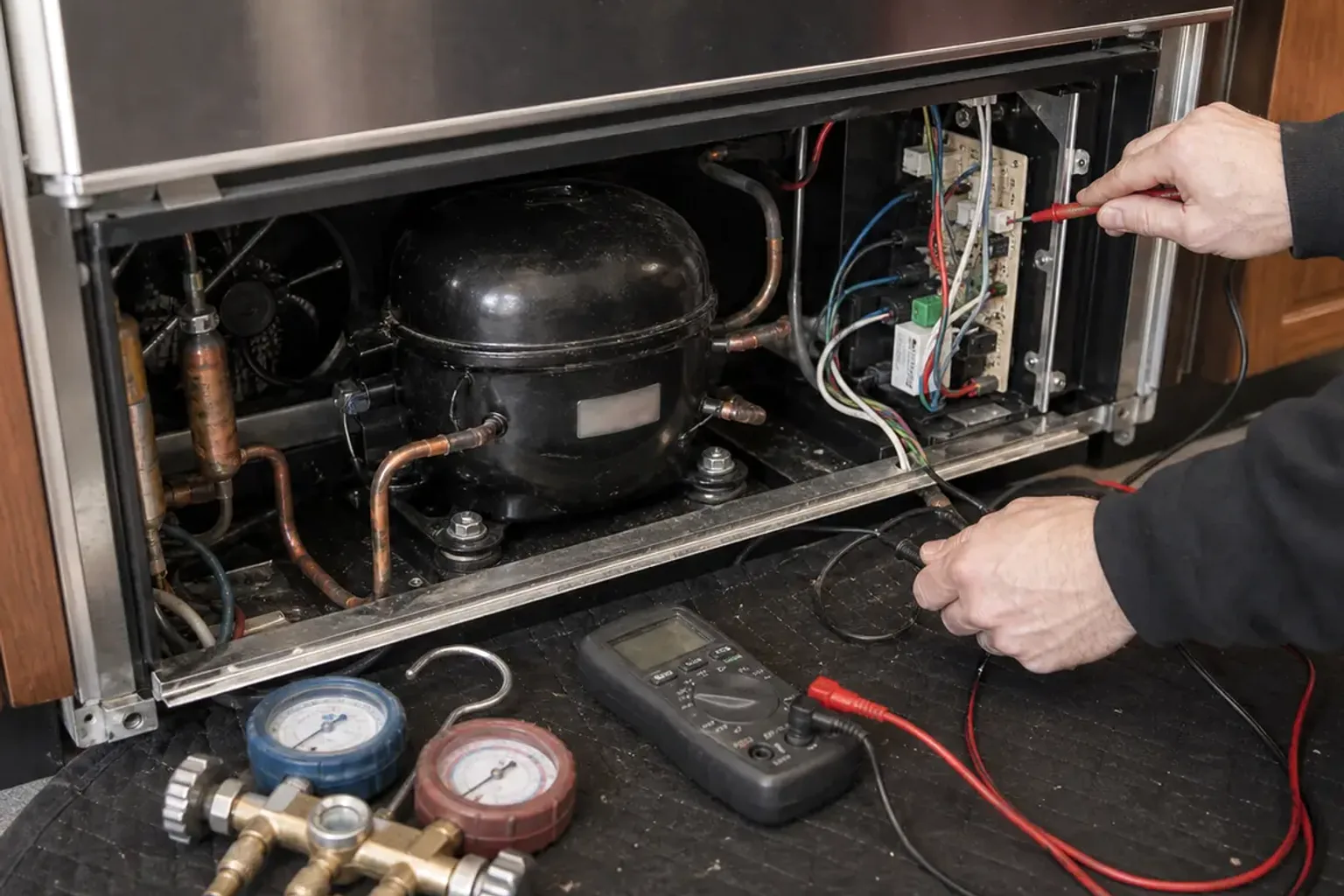
A Piedmont homeowner opens the built-in on a warm August morning, watches the fresh-food readout climb past 45F, and reaches for the panel. The correct target is 38F in the refrigerator and 0F in the freezer, with a wine column near 55F, and dialing a struggling Sub-Zero even colder rarely closes that gap. This guide from Piedmont Sub-Zero Repair walks the recommended setpoints, the panel steps that change them, and the moment a warm cabinet becomes a repair, not a settings problem.
What Temperatures Should a Sub-Zero Fridge, Freezer, and Wine Unit Hold?
Sub-Zero publishes tight targets for a reason: 38F holds fresh food safely without freezing produce, and 0F keeps a freezer's ice and proteins solid. A wine column sits warmer, around 55F for long-term cellaring, while a dual-zone drawer chills its beverage side into the low 40s. Dairy and greens last longest between 36F and 40F. Drift of a degree or two is normal as doors open across a busy Piedmont kitchen, but a readout stuck five or ten degrees high signals a problem beyond the dial.
Why Does Setting a Warm Sub-Zero Colder Not Fix a Cooling Fault?
Lowering the setpoint only tells the control board to run the same cooling system harder; it cannot restore capacity the hardware has already lost. If a Sub-Zero condenser is choked with dust or a sealed system is low on charge, the compressor was already running near-continuously at 38F, so asking for 34F just adds runtime and heat. A warm unit that ignores a colder command is reporting a fault, not a preference. Chasing the number downward masks the fault and can hasten compressor failure.
When Is a Warm Sub-Zero an Emergency Versus a Slow Drift?
Speed of change is the triage cue for any Sub-Zero built-in. A fresh-food compartment that jumps from 38F to 55F within an hour, with a softening freezer, is an emergency, since food-safety clocks start once the fridge passes 40F for two hours. A cabinet that creeps two or three degrees warm over weeks usually points to a gradual airflow or gasket issue. Frost on the back wall, water pooling, or a freezer at 20F instead of 0F all raise the urgency.
Which Cooling Faults Push a Sub-Zero Off Its Setpoint?
Several failures show up as a Sub-Zero cabinet that will not hold temperature. A dust-packed condenser strangles heat rejection, so the box drifts warm even with the compressor at full tilt. Failed evaporator or condenser fans stop moving cold air, leaving one zone warm while another over-freezes. A drifting thermistor feeds the board a false reading, and a leaking sealed system slowly loses its ability to cool. Each presents as a temperature complaint, which is why re-setting the dial fixes none.
How Do You Adjust the Setpoints on a Sub-Zero Control Panel?
Older Sub-Zero dial models and newer touch panels differ, yet the logic stays the same. On classic units, twist the fresh-food and freezer dials one notch at a time and wait several hours before judging. On digital built-ins, press the control lock or menu key, select the fresh-food or freezer zone, then step the target to 38F or 0F. A wine column offers its own zone selector for that 55F range. Change one setting per day so you can read the cabinet's true response.
How a Wine Column's Setpoints Differ From the Refrigerator
Wine storage optimizes for stability, not raw cold. A single-zone Sub-Zero wine unit near 55F protects corks and slows aging, while a dual-zone cabinet holds whites in the mid-40s and reds nearer 60F. Unlike the fresh-food box, a wine appliance punishes swings more than a slightly warm average, so vibration and a fluctuating readout do more harm than a steady 56F. When a Piedmont wine cabinet drifts several degrees or cycles hard, treat it as a fault worth diagnosing.
What Does It Cost to Fix a Sub-Zero That Won't Hold Temperature?
Pricing tracks the fault, not the thermostat. Piedmont Sub-Zero Repair opens with a $175 to $265 diagnostic that pins down why the cabinet drifts before parts are quoted. Condenser cleaning and airflow recovery runs $210 to $365, while a fan, thermistor, or control-branch repair falls between $410 and $1,190. A leaking sealed system or compressor is the costliest path at $1,025 to $2,925. Because a temperature complaint can trace to any of these, an accurate diagnosis prevents an unnecessary teardown.