
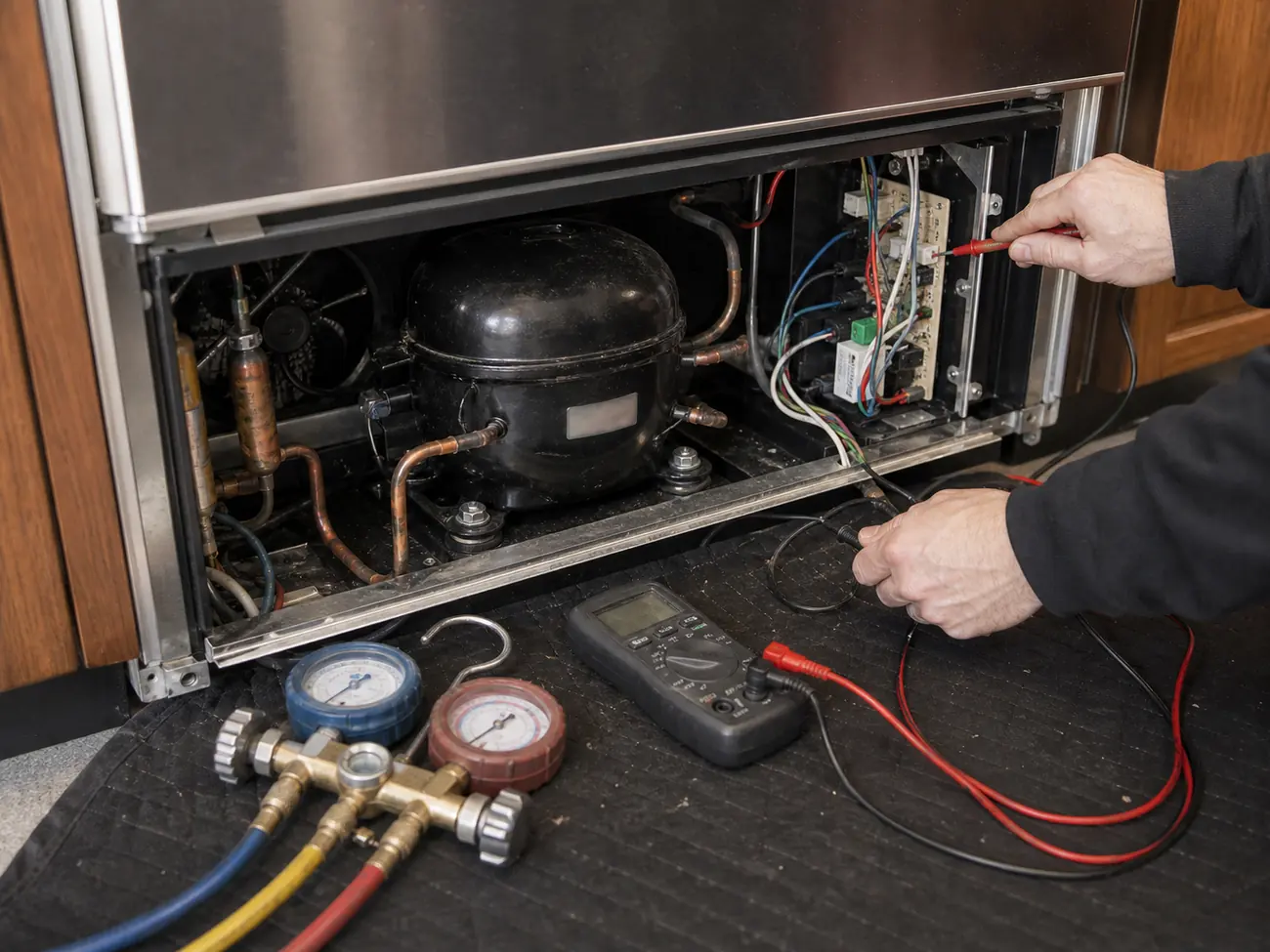
"Is it worth fixing, or should I just replace it?" In a Piedmont estate kitchen that question carries an extra weight it doesn't carry elsewhere: the built-in is usually a panel-front column wrapped in custom millwork, set into cabinetry that was built around it decades ago.
That changes the math. Replacing isn't just buying a new fridge — it's matching a discontinued size, re-fitting custom panels, and sometimes reworking the surround. So the decision deserves real readings, not a glance at the serial sticker.
What the replacement really costs here
Outside Piedmont, replacing a freestanding fridge is straightforward. Inside one of these kitchens it rarely is. A built-in column is sized to its opening, the custom door panels were made to match the room, and the cabinetry above and beside it was scribed to the unit.
Swap the appliance and you may also be paying for panel work, filler adjustments and sometimes a cabinet maker. That hidden cost is exactly why a sound older Sub-Zero is so often worth repairing here — the unit may be fifteen years old, but the installation around it is worth far more.
Reading the unit, not the age
Age alone never decides it. A failed evaporator fan, a tired door gasket, a clogged condenser, a control board or an ice-maker module are all bounded, well-stocked repairs on a unit built to run fifteen to twenty years — an easy yes.
A sealed-system fault, a refrigerant leak or a failing compressor is the expensive one. We put gauges on it and show you the pressures. On a newer column it's usually still worth fixing; on a much older unit facing a major sealed-system job, we'll show you the numbers and sometimes tell you it's time. We'd rather lose the repair than sell you one that doesn't add up.